Every Kid Had a Library Card and Every Adult Used It: The Slow Abandonment of America's Great Equalizer
The Democracy of Books
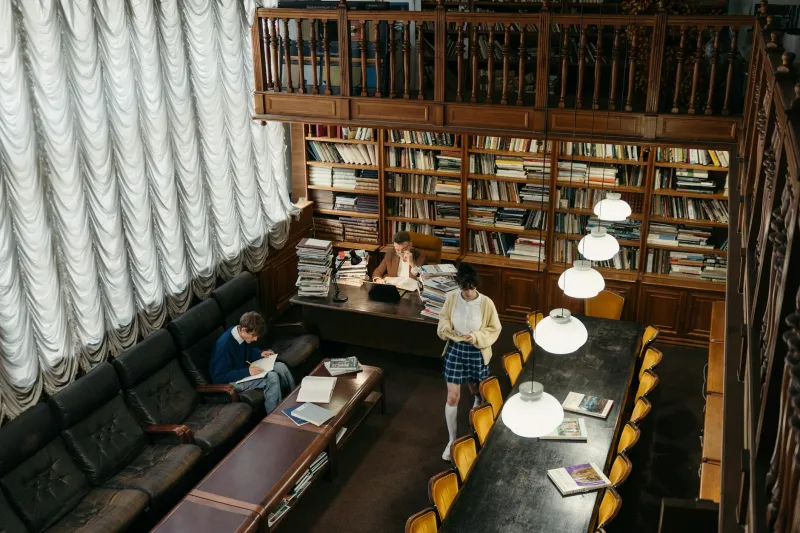
In 1975, the Millfield Public Library on Elm Street was the busiest place in town on Saturday mornings. Kids lined up at the circulation desk with stacks of books, their library cards worn soft from use. Adults browsed the new releases, settled into reading chairs with newspapers, and whispered questions to librarians who knew exactly which shelf held what they needed.
 Photo: Millfield Public Library, via ic-vt-nss.xhcdn.com
The banker's son and the factory worker's daughter sat at the same wooden tables, reading the same encyclopedias, working on the same homework assignments. The library was America's most successful experiment in equality—a place where your parents' income didn't determine your access to knowledge.
Today, that same library operates on half the hours with a third of the staff. The children's section is mostly empty, the reference desk unstaffed, and the parking lot that once overflowed now has plenty of spaces. We didn't close the library, exactly. We just stopped using it.
When Libraries Were Temples
The Carnegie libraries built in the early 1900s were designed to inspire. Grand staircases, soaring ceilings, and reading rooms that felt like cathedrals. The message was clear: knowledge is sacred, and every citizen deserves access to it.
 Photo: Carnegie libraries, via i.pinimg.com
By mid-century, every American community understood that a good library was as essential as good schools or clean water. Librarians were respected professionals, often the most educated people in small towns. They curated collections, guided research, and served as intellectual anchors for their communities.
Children grew up understanding that the library was theirs. Summer reading programs drew hundreds of kids. Story time was a weekly ritual for families. Getting your first library card felt like joining an exclusive club—except everyone was invited.
The Slow Fade
The decline didn't happen overnight. It started with budget cuts in the 1980s. Reduced hours here, eliminated positions there. Communities began to see libraries as nice-to-have rather than need-to-have.
Then came the internet. Why visit the library when you could look things up at home? Why browse the stacks when Amazon delivered books to your door? Why attend story time when kids had tablets and streaming services?
Each technological advance made the library seem a little less necessary. We gained convenience and lost community. We got faster answers but stopped asking better questions.
What the Numbers Tell Us
In 1996, Americans made 1.2 billion visits to public libraries. By 2018, despite a larger population, that number had dropped to 1.3 billion—essentially flat growth over two decades of population increase. Per capita, we're visiting libraries 20% less than we did in the 1990s.
Library book circulation peaked in 2005 and has declined every year since. Children's program attendance, once a library's bread and butter, has fallen 15% in the past decade.
Meanwhile, library funding has stagnated or declined in most communities. The average public library operates on a budget of $40 per resident per year—less than most Americans spend on coffee in a month.
The Digital Divide Deepens
Ironically, as libraries became less central to middle-class life, they became more essential for everyone else. Public libraries now serve as internet access points for people who can't afford home broadband. They're quiet study spaces for kids whose homes are too crowded or chaotic for homework. They're warming centers for the homeless and job search headquarters for the unemployed.
But this shift from universal institution to safety net has changed how we think about libraries. Instead of places that serve everyone, they're increasingly seen as services for people who can't afford alternatives.
This perception undermines public support. Middle-class voters who no longer use libraries are less willing to fund them. The result is a vicious cycle: reduced funding leads to reduced services, which drives away more users, which reduces political support for funding.
The Lost Art of Browsing
Google can find you exactly what you're looking for in 0.3 seconds. But libraries offered something different: the joy of discovering what you didn't know you were looking for. Wandering the stacks, you'd stumble across books that changed your perspective or opened new interests.
Librarians were human search engines, but better. They knew their collections intimately and could suggest connections that algorithms miss. They understood that research is often about following tangents and exploring unexpected paths.
The shift from browsing to searching has made us more efficient but less curious. We find answers faster but ask fewer questions.
Community in the Stacks
Libraries were social spaces in ways that bookstores and coffee shops never quite replicated. They were free, open to all, and designed for lingering. Teenagers did homework together. Parents attended parenting classes. Seniors played chess and discussed current events.
The library was often the only place where different generations and social classes naturally mixed. The retired professor and the single mother, the high school student and the small business owner—all sharing the same space, pursuing their own interests but part of a larger community of learners.
Streaming services and smartphones give us access to more information than any library could hold, but they're fundamentally isolating experiences. We consume alone, in our own bubbles, guided by algorithms that show us what we already like.
The Quiet Crisis
Libraries are dying quietly. They don't close dramatically—they just fade away, hour by hour, program by program, until they become ghosts of what they once were.
Some communities are fighting back. Modern libraries are reinventing themselves as maker spaces, community centers, and technology hubs. But these efforts often feel like desperate attempts to stay relevant rather than celebrations of what libraries do best.
What We're Really Losing
The decline of libraries represents more than the loss of a public service—it's the abandonment of a democratic ideal. The idea that knowledge should be free, that learning is a lifelong pursuit, that communities have a responsibility to educate all their members.
When we stop funding libraries, we're saying that access to information should depend on your ability to pay for it. When we stop using them, we're choosing convenience over community, efficiency over equality.
The library was America's promise that your zip code wouldn't determine your access to knowledge. That promise is quietly being broken, one closed branch and one reduced hour at a time.
Maybe it's time to remember why we built libraries in the first place—and decide whether that vision is still worth fighting for.


