The Grocery Cart Doesn't Lie. What Your Paycheck Could Actually Buy in 1965 vs. Today.
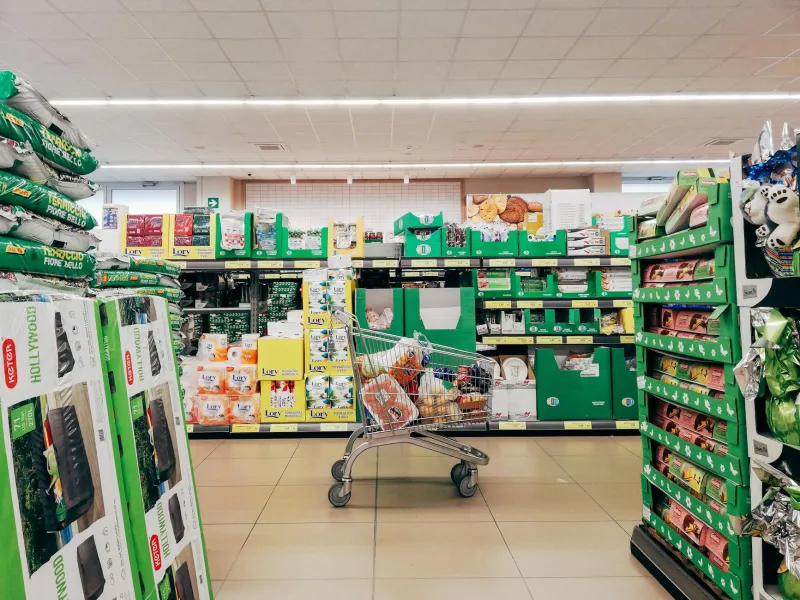
The Grocery Cart Doesn't Lie. What Your Paycheck Could Actually Buy in 1965 vs. Today.
There's a version of the past that lives in American memory like a warm photograph. Gas for a quarter. A steak dinner for two dollars. A family of four fed for the week on what you'd now spend on a single round of takeout. It's a comforting story. It's also, in important ways, incomplete.
The grocery store is one of the best places to measure how economic life has really changed — not because prices are simple, but because they're deceptive. What something costs and what it costs you are two very different questions, and the gap between them tells a more honest story about 60 years of American economic life than any nostalgia can.
What the Numbers Actually Looked Like
In 1965, a gallon of whole milk ran about 95 cents. A loaf of white bread was around 21 cents. A dozen eggs cost roughly 53 cents. Ground beef was about 45 cents a pound. On paper, that sounds extraordinary. But the federal minimum wage that year was $1.25 an hour.
Fast forward to today. That same gallon of milk averages around $3.80. Bread is closer to $4.00 for a standard loaf. Eggs — especially since the price spikes of recent years — can run $4.00 to $6.00 a dozen. Ground beef averages somewhere between $5.00 and $7.00 a pound depending on where you shop. The federal minimum wage sits at $7.25, though many states have set their own higher floors.
Now do the math in hours worked, not dollars spent.
In 1965, a minimum-wage worker needed roughly 45 minutes of labor to afford that gallon of milk. Today, at the federal minimum, it's about 30 minutes. Eggs that took 25 minutes of work to earn in 1965 now take a similar amount of time at current prices — though the recent egg shortage has tilted that balance. Ground beef, once roughly 22 minutes of work per pound, now runs about 40 minutes at minimum wage, though closer to 20 for someone earning $15 an hour.
The picture isn't uniform. And that's exactly the point.
The Things That Got Cheaper (And the Ones That Didn't)
Certain categories of food have genuinely become more affordable in real terms. Chicken is a striking example. In the 1960s, a whole chicken was a Sunday luxury in many households — it took real money and real time to prepare. Today, a rotisserie chicken at Costco costs $4.99, a price that hasn't changed in years despite inflation hitting nearly everything else. Boneless chicken breasts, adjusted for wages, are a fraction of what they were in 1960.
The same is broadly true for processed and packaged foods. Cereal, canned goods, frozen meals, snacks — mass production, global supply chains, and agricultural efficiency have made these items far cheaper relative to income than they were for your grandparents.
But fresh produce tells a different story. Fruits and vegetables, particularly anything organic or out of season, have risen faster than wages in many parts of the country. The same goes for seafood, specialty items, and anything that resists industrial scaling. A 1960s household in the Midwest ate what was cheap and local. The modern expectation of fresh blueberries in February comes at a cost that compounds quietly.
And then there are the costs that don't show up in the grocery receipt at all.
The Hidden Taxes on the Modern Shopping Trip
In 1965, a family with a single breadwinner earning a median income could typically cover housing, food, and basic expenses without a second paycheck. Today, that equation has fundamentally shifted. Housing costs have outpaced wage growth significantly over the past four decades. Healthcare, childcare, and education costs have all risen dramatically faster than inflation.
This matters for the grocery conversation because it changes how much of a paycheck is available before anyone sets foot in a store. A mid-century household spending 20 percent of its income on food was in a very different position than a modern household where housing alone can consume 35 to 40 percent of take-home pay.
The grocery cart, in other words, doesn't exist in isolation. What feels expensive at checkout is partly a function of what's already been spent before you even walk through the sliding doors.
So Was the Past Actually Cheaper?
Depends on what you're buying — and who you were.
For white, middle-class families with a single income, a unionized job, and access to affordable suburban housing, the mid-century economy genuinely delivered a lot. Food was a meaningful portion of the budget, but it was manageable, and the basket of goods available was simpler.
For Black families, rural households, and low-wage workers, mid-century America was often a much harsher economic environment, with fewer protections, less access to credit, and no shortage of structural barriers that price comparisons don't capture.
The honest answer is that some things have gotten cheaper in real terms, some have gotten more expensive, and the overall picture depends enormously on income level, geography, and what you actually need to live.
The next time someone sighs about milk being under a dollar, it's worth doing the math. Sometimes the past was genuinely more affordable. Sometimes it just looks that way because we're forgetting what people were earning to pay for it.