Before GPS, Getting Anywhere New Was a Small Act of Courage. Here's How Lost We Actually Were.
Before GPS, Getting Anywhere New Was a Small Act of Courage. Here's How Lost We Actually Were.
There's a particular feeling that younger Americans have essentially never experienced. It's the sensation of being in an unfamiliar city, in a car, at night, with no idea where you are and no way to quickly find out. Not a brief moment of confusion before you check your phone. Actual, sustained, low-grade lostness — with no resolution except to keep driving and hope something looks familiar.
If you grew up in the 1980s or early 1990s, you know exactly what that felt like. If you didn't, it's almost impossible to convey just how routine that experience was.
We were lost constantly. We just didn't have a word for it, because it was simply life.
The Art of Getting Directions
Let's say it's 1987. You've just moved to a new city — Cincinnati, maybe, or Sacramento — and a coworker invites you to a party at her place across town. She gives you directions over the phone.
You write them down on whatever's nearby. A paper bag. The back of an envelope. A Post-it if you're organized. The directions sound like this: "Take 71 north to the Montgomery exit, go left at the light, past the Kroger, turn right at the second stop sign, it's the yellow house, you can't miss it."
You absolutely could miss it. You missed it all the time. The Kroger she mentioned closed six months ago. The second stop sign is actually the third one if you count the partial intersection. The house looks beige in the dark, not yellow.
So you circled. You pulled over. You got out and asked someone on the street. Or you found a payphone, called your coworker again, and tried to describe what you could see from where you were standing while she tried to triangulate your location from landmarks you both hoped were identifiable.
This was normal. This was just what getting somewhere new looked like.
The Road Atlas Was a Sacred Object
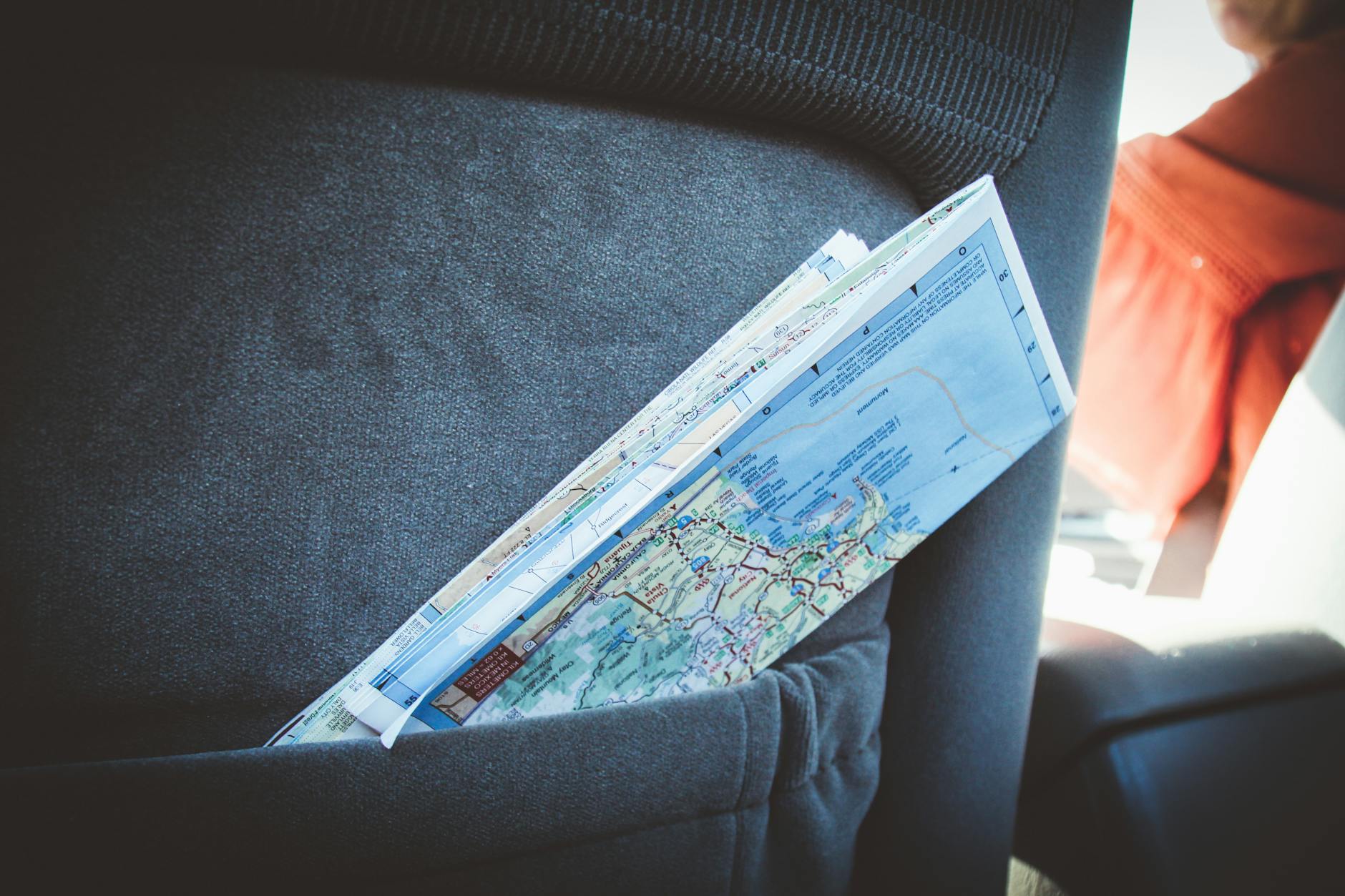
Every American car worth its registration had a road atlas in the back seat or the trunk — a thick, spiral-bound book of maps published by Rand McNally or AAA, usually a few years out of date, with pages that had been folded wrong so many times they no longer lay flat.
Planning a road trip meant sitting at the kitchen table the night before with the atlas open, tracing your route with a finger, writing down the highway numbers and major towns in sequence on a notepad you'd keep on the passenger seat. If you had a co-pilot, they navigated. If you were driving alone, you memorized as much as you could and pulled over when things stopped making sense.
Some people were genuinely skilled at this. They could hold a mental map of a route, anticipate exits, and almost never get turned around. Others — and this group was large — treated every unfamiliar drive as a mild adventure with an uncertain outcome.
Trip planning involved calling AAA, which would mail you a "TripTik" — a custom strip map of your route, page by page — and a packet of hotel suggestions. This service was considered a marvel of convenience. And by the standards of what came before it, it genuinely was.
What Getting Lost Actually Felt Like
Here's what the nostalgia-soaked version of this story tends to leave out: getting lost was often stressful in ways that weren't charming at all.
Traveling alone in an unfamiliar area before GPS meant that a wrong turn could cascade. You'd miss an exit, try to course-correct, get turned around on surface streets, and burn 45 minutes going in roughly the wrong direction before finding a gas station attendant who could reorient you. Job interviews were missed. Flights were nearly missed. First dates arrived late and flustered.
Women traveling alone faced a particular version of this anxiety — pulling over to ask for directions in an unfamiliar neighborhood at night carried risks that had nothing to do with navigation. The decision to stop and ask, or to keep driving and hope, was a genuine calculation.
And then there was the dead zone of the pre-cell phone era, where being lost also meant being unreachable. Nobody knew where you were. You couldn't call ahead to say you were running late. You just arrived when you arrived, or didn't arrive at all, and nobody knew the difference until the absence became conspicuous.
When GPS Arrived, We Barely Noticed the Revolution
Consumer GPS navigation existed in crude form by the mid-1990s — expensive, clunky dedicated devices that were mostly used by truckers and serious travelers. The real democratization happened in the mid-2000s, when Garmin and TomTom brought affordable dashboard units to mainstream America. Then the iPhone arrived in 2007, and within a few years, turn-by-turn navigation was in every pocket.
The transition was so gradual that we never really stopped to appreciate what had happened. Spatial anxiety — that constant low-grade uncertainty about whether you were going the right way — just quietly evaporated. Getting lost became almost a choice. You have to actively ignore your phone to achieve the kind of disorientation that used to be routine.
Did We Lose Something Real?
There's a legitimate argument — not just a sentimental one — that something was lost along with the anxiety.
Navigating without GPS required you to build a mental model of your surroundings. You learned cities by moving through them imperfectly, by making wrong turns that accidentally taught you where things were. Research on spatial cognition suggests that people who navigate with GPS develop weaker internal maps of their environments than those who navigate independently. We may be outsourcing a cognitive skill that we're slowly losing the ability to perform.
There's also something to be said for the accidental discoveries that lostness produced. The diner you found because you took the wrong exit. The neighborhood you stumbled into that became your favorite. When the route is always optimized, the detours disappear — and so do the surprises.
But it's worth being honest: most people, given the choice, would take the reliable turn-by-turn directions over the adventure of being genuinely, anxiously, inconveniently lost on a Tuesday night in a city they don't know.
We traded a real inconvenience for a real convenience. The map in our heads got a little smaller. The world, in exchange, got a little more navigable.
Whether that was a fair trade probably depends on how good you were at folding a road atlas.