The Man Who Came to Your Door: Whatever Happened to the Street Economy That Once Defined American Neighborhoods?
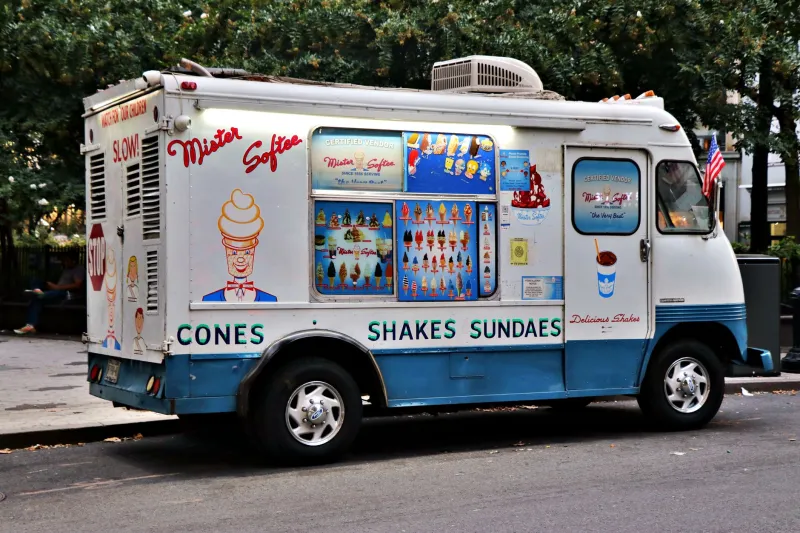
Somewhere in the back of the American collective memory, there's a sound. It's the tinny, slightly off-key melody of an ice cream truck working its way down a residential street on a July afternoon, and it means summer is here and you have exactly ninety seconds to find a quarter before it rounds the corner and disappears. If you grew up in an American suburb or city neighborhood any time between the 1940s and the 1980s, you know that sound. You can probably still hear it.
But the ice cream truck was just one character in a much larger cast — a whole informal economy that showed up at your door, rang the bell, and made daily commerce feel less like a transaction and more like a visit. That world is almost entirely gone now. And the disappearance was so gradual that most people never noticed it happening.
The Daily Cast of Characters
Let's reconstruct the scene. In a typical American city neighborhood in, say, 1952, a household might interact with a surprising range of mobile commerce throughout the week.
The milkman came before dawn, leaving glass bottles on the porch and collecting the empties. He knew which families needed an extra quart on Sundays, which ones had just had a baby and would be needing more. The bread man came in a white truck that smelled like something out of a dream. The vegetable cart — in many urban neighborhoods, often pushed by hand — rolled through on Tuesday and Thursday mornings, the vendor calling out his prices in a voice trained to carry half a block.
The knife sharpener arrived periodically, sometimes announced by the distinctive whirring of his grinding wheel mounted on a bicycle or a modified cart. Housewives would bring out their kitchen knives and scissors, and he'd sharpen them on the spot for a few cents. The rag-and-bone man collected old clothing, scrap metal, and worn-out household items — an informal recycling economy that predated the environmental movement by decades. The insurance man came monthly to collect premiums in cash, sitting at the kitchen table for a few minutes and keeping up with family news in the process.
And then there were the door-to-door salesmen — Fuller Brush, Avon, Encyclopedia Britannica, Electrolux vacuums — who built entire careers on the art of the front-porch conversation. At their peak in the 1950s and 1960s, direct sales companies employed hundreds of thousands of Americans, mostly women in the case of Avon, in a model that turned neighborhoods into sales territories and personal relationships into commercial networks.
What Made It Work
This wasn't just commerce. It was the metabolism of the neighborhood — the daily and weekly rhythm of familiar faces, small transactions, and brief human exchanges that stitched residential streets into actual communities.
Consider what the milkman actually represented. He was a reliable, known presence who visited your home more regularly than most relatives. He knew your family's patterns. If the bottles went uncollected for a day, he noticed. There are documented cases of milkmen alerting neighbors or calling for help when they realized something was wrong at a house on their route — an elderly customer who hadn't taken in their bottles, a family whose order had inexplicably stopped. The commercial relationship carried a layer of informal community watchfulness that nobody had designed but everyone benefited from.
The same was true of the door-to-door salesman. Yes, he was there to sell you something. But he was also a connection point — a person who moved through the neighborhood, carried information, and provided a moment of adult conversation in an era when many women spent long hours at home with small children and limited social contact. The Avon lady wasn't just selling lipstick. She was maintaining a social circuit.
The Slow Disappearance
The street economy didn't collapse all at once. It eroded piece by piece through the second half of the twentieth century, each element undone by a different combination of forces.
Milk delivery peaked in the early 1960s and then faded rapidly as supermarkets expanded and refrigeration made the daily delivery model unnecessary. By 1975, home milk delivery had dropped by more than 80 percent from its postwar high. The bread man followed a similar trajectory. Vegetable carts retreated from neighborhoods as supermarket chains offered more variety at lower prices. Knife sharpeners became rare enough to seem eccentric. The Fuller Brush man became a cultural punchline before quietly vanishing from most neighborhoods by the 1980s.
The ice cream truck held on longer, but it too has become a shadow of its former self. Regulatory changes, insurance costs, traffic patterns in car-centric suburban developments, and the sheer economics of fuel and labor have made the business increasingly unworkable in most markets. In many American cities today, an ice cream truck sighting is an event worth remarking on.
What replaced all of it? First the superstore, then the big-box retailer, then e-commerce, then the delivery app. Commerce didn't disappear — it became more efficient, cheaper, and more convenient by almost every measurable standard. You can order groceries, prepared meals, household goods, and yes, ice cream, from your phone and have them at your door in under an hour in most American cities.
But the person who brings it doesn't know your name. They won't notice if your bottles go uncollected. They're not going to sit at your kitchen table for five minutes and ask how the kids are doing.
The Thing We Can't Deliver
Efficiency is a genuine good. Nobody seriously wants to go back to a world without refrigerators or supermarkets. The economics that killed the street economy were, in most respects, real improvements in how goods and services reach people.
But there's a reason the ice cream truck melody still triggers something in people who haven't heard it in decades. It wasn't really about the ice cream. It was about the moment — the shared excitement on the block, the scramble for change, the brief congregation of neighbors around a common experience. It was about commerce as a social act rather than a logistical one.
We've built an extraordinarily efficient system for moving products from warehouses to doorsteps. What we haven't figured out how to deliver, through any app or algorithm, is the incidental human contact that the old street economy generated as a natural byproduct of doing business.
The knife sharpener who wheeled his bicycle down your street wasn't just keeping your kitchen knives sharp. He was, in some small but real way, keeping the neighborhood alive.


