Gone by Nine, Back by Dark: The Extraordinary Freedom American Children Used to Have — and Who Took It Away
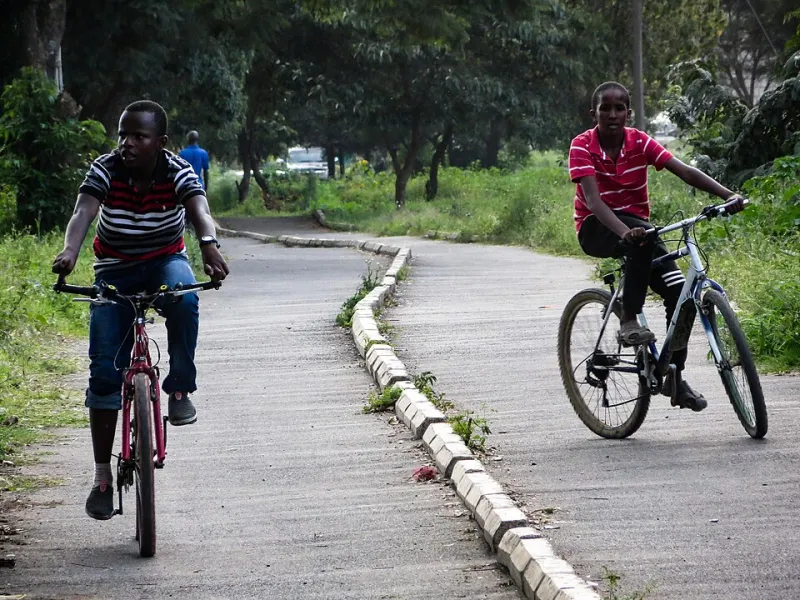
Photo: Victor Kibiwott, CC BY-SA 4.0, via Wikimedia Commons
The Geography of a 1970s Childhood
Ask someone who grew up in suburban America in the 1970s to describe a typical summer day, and you'll hear a version of the same story. Wake up, eat cereal, go outside. Return home when the streetlights came on or when hunger became impossible to ignore. In between: miles covered on a bicycle, creeks explored, neighborhoods wandered, disputes settled without adult mediation, scraped knees treated with a garden hose.
Parents knew roughly where their kids were, in the way you know roughly where a cloud is — general direction, no precise coordinates. And nobody considered this neglect. It was just Tuesday.
That world is gone. Not gradually faded, but structurally dismantled — through legal pressure, cultural anxiety, media amplification, and a fundamental reimagining of what responsible parenting looks like. The result is a generation of children whose physical world has shrunk to a fraction of what their parents knew, supervised at nearly every waking moment, and whose parents can face real legal consequences for offering them the same independence that was once considered basic childhood.
What the Data Actually Shows
Here's the uncomfortable truth at the center of this story: America is not meaningfully more dangerous for children than it was in the 1970s. In most measurable ways, it's significantly safer.
Child abduction by strangers — the fear that quietly underlies most modern parenting anxiety — is extraordinarily rare, and it was extraordinarily rare then too. The FBI has tracked these statistics for decades. The number of children abducted by strangers in any given year in the United States is somewhere between 100 and 150. In a country of 330 million people, with roughly 74 million children, that's a statistical risk so small it barely registers.
The cases that do occur receive massive, sustained media coverage — which is entirely understandable, because they're genuinely horrifying. But that coverage creates a distorted picture of how common the danger actually is. Parents in 1975 didn't have 24-hour cable news cycling through worst-case scenarios. They had a local newspaper and Walter Cronkite. The world felt safer partly because the machinery for making it feel dangerous hadn't been fully built yet.
Traffic fatalities involving children are down sharply. Violent crime rates in most American cities are lower than they were in the early 1990s. By almost every objective measure, the physical environment children move through is less dangerous than it was during the era when they were given the most freedom.
The Legal Machinery of Helicopter Parenting
What changed wasn't the danger. What changed was the cultural and legal framework around parenting itself.
Through the 1980s and '90s, child protective services agencies expanded significantly, and with that expansion came a broadening definition of what constituted neglect. Leaving a child unsupervised — even briefly, even in a safe environment — became something that could trigger investigation, intervention, and in some cases, the removal of children from homes.
The cases that made national news were instructive. A Maryland couple, Danielle and Alexander Meitiv, let their children — ages 10 and 6 — walk home from a park in 2015. They were investigated twice by child protective services. A South Carolina mother was arrested in 2014 for letting her nine-year-old play alone in a park while she worked a nearby shift at McDonald's. In both cases, the children were by any reasonable measure fine. The parents were not.
These stories spread. Other parents took note. The rational response to a legal system that could punish you for allowing your child independence was to stop allowing your child independence. Fear of judgment — from neighbors, from authorities, from other parents — became a more powerful force shaping childhood than any actual assessment of risk.
What Children Lost in the Contraction
The developmental consequences of this shift are increasingly well-documented, and they're not minor.
Unsupervised outdoor play is one of the primary environments in which children develop genuine autonomy — the capacity to make decisions, assess situations, manage risk, and recover from mistakes without an adult present to smooth the edges. It's where children learn to negotiate conflict without a referee, to entertain themselves without a program, and to develop the quiet confidence that comes from navigating the world on their own terms.
Researchers including psychologist Peter Gray have tracked the parallel rise in helicopter parenting and the increase in childhood anxiety, depression, and what Gray calls a crisis in the development of autonomy. The correlation isn't coincidental. Children who never practice independence don't automatically acquire it at eighteen. They arrive at adulthood without having developed the internal resources that come from years of low-stakes self-direction.
College counselors and employers have both noted the shift. The language used to describe it varies — 'fragility,' 'risk aversion,' 'difficulty with ambiguity' — but the underlying observation is consistent: something is different about young people who grew up never being allowed to figure things out on their own.
The Neighborhood That Stopped Watching Out
There's another loss here that's harder to quantify. In the era of free-roaming childhood, neighborhoods functioned as loose, informal safety networks. Adults knew the kids on the street. If something seemed wrong, a neighbor would step in — not to call the authorities, but because that's what neighbors did.
That social fabric has frayed significantly. As children disappeared from outdoor spaces, adults stopped expecting to see them there. The informal surveillance that came from a street full of playing kids — dozens of eyes, constant low-level awareness — evaporated. Paradoxically, the effort to protect children by keeping them inside may have made the outdoor environment feel more unfamiliar and therefore more threatening to the adults who remained in it.
A Few States Pushed Back
It's worth noting that some states have begun legislating in the other direction. Utah passed the first 'free-range parenting' law in 2018, explicitly protecting parents who allow their children age-appropriate independence from neglect charges. Oklahoma, Texas, and a handful of other states followed with similar protections.
It's a telling sign of how far things shifted that laws had to be written to confirm that a ten-year-old walking to school alone is not a crime.
The kid on the bike, three miles from home, figuring out the route back — that child was learning something that couldn't be taught in a classroom or scheduled into an after-school program. They were learning that the world was navigable, and that they were capable of navigating it.
We told a generation of children that the world was too dangerous for that lesson. The evidence suggests we were wrong — and that the cost of that mistake is still being calculated.